Beti Bachao Beti Padhao: Evaluation of The Social Impact of The Scheme in Goa
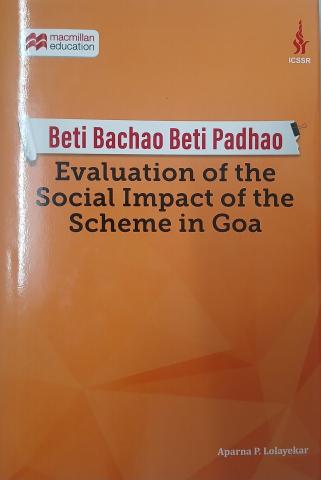
Author : Aparna P. Lolayekar, Avina A. Kavthankar & Kajal P. Rivankar
Co-publisher: Indian Council of Social Science Research (ICSSR), in association with Macmillan Education India Private Limited.
Publication Year : 2026
Price : 855
About the Book
The 2030 Agenda for Sustainable Development and its 17 Sustainable Development Goals (SDGs) provide a roadmap for inclusive progress, with a continued focus on addressing gender inequalities in healthcare and education. In India, these concerns led to the launch of the Beti Bachao Beti Padhao (BBBP) scheme in 2015 to improve the status of the girl child through a multi-sectoral approach. This book presents an in-depth evaluation of the BBBP scheme in the state of Goa, examining its implementation, impact, and effectiveness. By combining official reports, empirical analysis, and field-level insights, it offers a realistic understanding of both achievements and challenges. The study assesses key outcomes such as sex ratio at birth, girls' education, and access to health services, while also examining the role of awareness campaigns in shaping societal attitudes toward gender equality. By situating Goa's experience within the broader national context, the book contributes to discussions on how policy interventions can bring about meaningful and sustainable change for girls and women.
The book is sure to contribute as a policy-oriented document; useful to the policymakers by proposing strategies that need to be implemented to increase the effectiveness of the programmes. It also adds to the overall theme of gender equality by strongly reiterating the need for the overall welfare of girl child through education, inclusion and support for socio-cultural upliftment to achieve sustainable development.
About the Authors
Dr. Aparna P. Lolayekar is Professor of Economics at the Goa Business School Goa University, Goa, India. She holds a PhD and a Master's Degree in Economics from Goa University and has been actively engaged in postgraduate teaching in the Economics Discipline. With over two and a half decades of teaching research experience, her areas of specialisation include Development Economics, Economics of Crime, Gender and Development, and Public Policy. She has authored research articles in reputed international peer-reviewed journals and has led several policy-oriented research projects funded by the Indian Council of Social Science Research (ICSSR), the Finance Commissions of India and the Goa State Research Foundation (GSRF). She is a life member of the Indian Econometric Society and the Indian Economic Association and has supervised research in both Economics and Women's Studies.
Ms. Avina A. Kavthankar is an Assistant Professor of Economics at Goa Business School, Goa University, with over eight years of teaching experience in undergraduate and postgraduate programs. She holds a Master's degree in Economics and is currently pursuing her PhD at Goa University, focusing on Human Development and Women's Health in India. Her academic interests include Growth and Development Economics, Health Economics, Gender and Development, and Public Policy.
Dr Kajal P. Rivankar is an Assistant Professor in the Social Work Discipline at the D.D. Kosambi School of Social Sciences and Behavioural Studies at Goa University. She holds a Master's degree in Social Work from Savitribai Phule Pune University and a PhD in Women's Studies from Goa University. She has served as Project Coordinator for the Sanghmitra project supported by the National Mission for Empowerment of Women, Government of India and has contributed to the INFUSE initiative on sustainability education and menstrual health.
| Contents | |
|---|---|
| List of Figures | |
| List of Tables | |
| Acronyms/Abbreviations | |
| Acknowledgements | |
| Chapter 1 | |
| 1.1 Introduction | |
| 1.2 Overview | |
| 1.2.1 Gender Discrimination and Technology | |
| 1.2.2 Gender Composition and Regional Variations in India | |
| 1.2.3 Interventions to Address the Sex Ratio | |
| 1.3 Context | |
| 1.3.1 Phases of the Implementation of the Scheme | |
| 1.3.2 Major Components of the Scheme | |
| 1.4 Monitorable Targets | |
| 1.5 Objectives of the Scheme | |
| 1.6 Target Groups or Intended Beneficiaries of the Scheme | |
| 1.7 Stakeholders of the Scheme | |
| 1.8 Implementation of the BBBP Scheme in Goa | |
| 1.8.1 Key Demographic Indicators of Goa | |
| 1.8.2 Population: District-wise | |
| Chapter 2 | |
| 2.1 Evaluation Framework | |
| 2.2 Objectives | |
| 2.3 Research Questions | |
| 2.4 Research Methodology | |
| 2.4.1 Sources of Data | |
| 2.4.2 Primary Survey Methodology | |
| 2.4.3 Sample Design, Sample Size, Coverage of Respondents and Other Stakeholders | |
| 2.4.4 Methods of Sample Selection | |
| 2.4.5 Questionnaire, Schedule and Focused Group Discussion | |
| 2.4.6 Pilot Testing of Interview Schedule | |
| 2.4.7 Limitation and Mitigation Strategies | |
| Chapter 3 | |
| 3.1 Sample Respondents and Other Stakeholders | |
| 3.1.1 Spatial Representation: State-wise/Region-wise/District-wise | |
| 3.1.2 Target Groups | |
| 3.1.3 Nature of the Respondents (Household Survey) | |
| 3.2 Representation of the Survey Data | |
| 3.3 Demographic and Social Characteristics of the Respondents under the Household Survey | |
| 3.4 Economic Characteristics of the Respondents | |
| 3.5 Characteristics of School Data | |
| 3.5.1 School Details | |
| Chapter 4 | |
| 4.1 Background and Context | |
| 4.2 Current Status of Implementation of Scheme/Programme | |
| 4.2.1 Highlights of the Strategic Action Taken | |
| 4.2.2 Details of the Meeting of STF and DTF | |
| 4.2.3 Content Analysis of Few Major DTF and STF Meetings | |
| 4.3 Activities Conducted by Various Departments | |
| 4.3.1 Directorate of Women and Child Development | |
| 4.3.2 The Directorate of Health Services, Goa | |
| 4.3.3 Directorate of Education | |
| 4.3.4 NGO-Children's Rights in Goa | |
| 4.4 Training and Capacity Building | |
| 4.5 Advocacy, Community Mobilisation, and Awareness Generation | |
| 4.6 Reporting and Documentation | |
| 4.7 Budgetary Provision and Actual Spending under BBBP Scheme | |
| 4.8 Budgetary Provision Made and Actual Spending Done under Various Major Schemes Related to Girl Child | |
| Chapter 5 | |
| 5.1 Findings and Observations | |
| 5.1.1 Sex Ratio at the State, District and Taluka Levels | |
| 5.1.2 Sex Ratio at Birth and Male and Female Live Births | |
| 5.1.3 Intertemporal and Spatial Variation in SRB | |
| 5.1.4 Child Mortality Rates | |
| 5.2 Healthcare Facilities across Goa | |
| 5.2.1 Maternal Healthcare Trends in North and South Goa District | |
| 5.2.2 Child Birth Trends in Goa | |
| 5.2.3 Comparison of Delivery Trends in North and South Goa | |
| 5.2.4 Stillbirths, Abortions and MTPs in North Goa and South Goa | |
| 5.2.5 Status of ANC Registration | |
| 5.3 Gross Enrolment Ratio and Drop-out Rate in Goa | |
| 5.4 Thematic Analysis for Household Data | |
| 5.4.1 General Awareness about the Issues of Gender Imbalance and Female Infanticide | |
| 5.4.2 Awareness, Perception and Impact of BBBP Scheme | |
| 5.4.3 Maternal Health and Well-being within the Framework of the BBBP Scheme | |
| 5.4.4 Care for Lactating Mothers | |
| 5.4.5 Role of Parents in Supporting Girls' Welfare and Empowerment | |
| 5.4.6 Perception of the Young and Adolescents on Gender Equality and Implementation of the BBBP Campaign | |
| 5.4.7 Experiences of Newly Married Couples under the BBBP Campaign | |
| 5.4.8 Exploring Perspectives on the BBBP Scheme through Thematic Analysis of Goan and Migrant Communities | |
| 5.4.9 Social Category-wise Observations and Findings | |
| 5.4.10 Geographic Area-wise (rural/urban) Observations | |
| 5.5 Thematic Analysis for School Survey Data | |
| 5.5.1 Sensitisation of Teachers on Child Sex Ratio through Samagra Shiksha Abhiyan | |
| 5.5.2 Role Played by the School Management Committees for the Benefit of the Girl Child | |
| 5.5.3 Encouragement to the Girl Child through Balika Manch | |
| 5.5.4 Awards Given to Promote Girl's Education | |
| 5.5.5 Promote a Protective Environment for Girl Children | |
| 5.5.6 Institutionalize Standard Guidelines/Protocols for Girl Child Friendly Schools | |
| 5.6 Content Analysis | |
| 5.6.1 Suggestions Given by Household Survey Respondents | |
| 5.6.2 Suggestions Given during School Survey | |
| 5.7 Quantitative Analysis of the Data | |
| 5.7.1 Socio-economic Determinants of Gender Imbalance Awareness | |
| 5.7.2 Assessing the Impact of BBBP Interventions on Girls' School Enrollment | |
| 5.8 Findings and Observations | |
| 5.8.1 Best Practices | |
| 5.8.2 Focused Group Discussion - Feedback of the Scheme/Programme | |
| 5.8.3 Gap in Scheme Design Observed | |
| 5.8.4 Challenges for Scheme Implementation Observed | |
| 5.8.5 Fulfilment of the Objectives of the Study | |
| 5.8.6 Revisiting the Hypothesis | |
| Chapter 6 | |
| 6.1 Recommendations of the Study | |
| 6.2 Thematic/Sectoral Recommendation | |
| 6.3 Opinion on the Inclusion of New Stakeholders | |
| 6.4 Suggestions on a New Course of Action | |
| 6.5 Suggestions for Future Research | |
| References | |
| Notes on the Contributors | |