Millet Production in Uttarakhand: An Empirical Analysis of Its Socio-economic Impact & Marketability Challenges
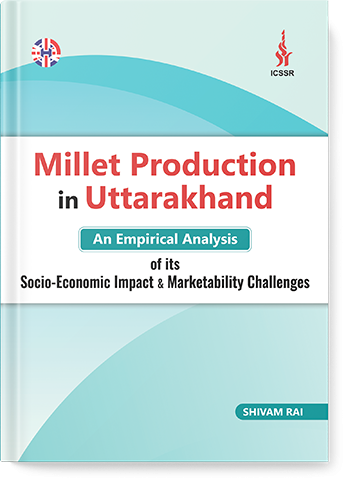
Author : Shivam Rai, Gaurav Kabra, Deepak Sangroya & Nishant Singh
Co-publisher: Indian Council of Social Science Research (ICSSR), in association with HP Hamilton India.
Publication Year : 2026
Price : 440
About the Book
This book contributes to sustainable agriculture and rural transformation discourse. It offers an evidence-based analysis of millet cultivation and consumption in Uttarakhand, linking traditional practices with contemporary market dynamics. By emphasizing millets as "nutri-cereals," the book highlights their potential to address food security, climate change, and sustainable agriculture, aligning with broader sustainability and development objectives. The text critically examines the millet value chain, identifying bottlenecks like weak market linkages, inadequate infrastructure, pricing inefficiencies, and limited farmer awareness. It proposes a strategic roadmap for strengthening supply chains, promoting value-added products, and enhancing market access and consumer awareness. The book's market-oriented, stakeholder-inclusive approach adds depth to the analysis. Overall, it is academically rigorous and socially pertinent, making it essential for researchers, policymakers, and practitioners dedicated to advancing sustainable agriculture
About the Author
Dr. Shivam Rai is an accomplished academic and researcher in marketing area, currently serving as a faculty member at the Indian Institute of Management Kashipur. Dr Rai holds a doctorate degree from the Indian Institute of Technology Roorkee. He has been previously associated with XIM University, Bhubaneswar, and Jindal Global Business School as a faculty member in the marketing area. Transitioning from an industry background in the business event and software services sectors, Dr. Rai's industry insights significantly enrich his research and academic approach. Dr. Rai's research work spans areas such as marketing, consumer psychology, digital innovation and sustainable consumption.
Dr Gaurav Kabra is an associate professor at Fore School of Management with a diverse background in Information Technology and Supply Chain Management. He earned his PhD from IIT Roorkee, a five-year integrated B.Tech in Information Technology, and an MBA from ABV-ITM Gwalior.
Dr. Deepak Sangroya is an Associate Professor of Marketing at Jindal Global Business School, O.P. Jindal Global (Institution of Eminence Deemed To Be University). He has a rich blend of work experience from both Academics as well as Industry. Prior to joining JGBS, he taught at reputed institutions like Bennett University and Symbiosis Centre for Management and HRD, Pune.
Dr Nishant Singh is a faculty member with the School of Management, Bennett University, Greater Noida. He holds a Doctorate from IIT Roorkee. Prior to joining Bennett University, he had worked in the FMCG industry and taught at CMS Business School, Bengaluru.
| Contents | |
|---|---|
| Acknowledgements | |
| Introduction | |
| 1. | Millet: The Nutri-Cereal Crop |
| 1.1. Types of Millets in India | |
| 1.2. Historical Origins of Millets | |
| 1.3. Millet: Stages of Processing | |
| 2. | Millets: Their Importance |
| 2.1. Nutritional Value of Millets | |
| 2.2. Weight Management | |
| 2.3. Agriculture and Sustainability | |
| 2.4. Climate Resilience | |
| 2.5. Economic Importance | |
| 3. | Millet Cultivation Practices in Uttarakhand |
| 3.1. Millet Varieties Cultivated | |
| 3.2. Seasons of Millet Cultivation | |
| 3.3. Traditional Farming Techniques | |
| 3.4. Rain-Fed Agriculture | |
| 3.5. Soil and Water Management | |
| 3.6. Pest and Disease Management | |
| 4. | Millet Types with their Respective Scientific Names and Vernacular Names |
| 5. | Production of Millet in India |
| 5.1. Changing Trends Millet Supply and Demand | |
| 5.2. Strengthening the Millet Chain | |
| 5.3. Constraints in the Production of Millets | |
| 5.4. Gaps in the Supply Chain of Millets | |
| 6. | Research Approach |
| 6.1. Research Objective | |
| 6.2. Research Design | |
| 6.3. Research Methodology | |
| 6.4. Analysis of the Data | |
| 7. | Variables |
| 7.1. Measurable Demographic Variables | |
| 7.2. Socio-Economic Variables | |
| 8. | The Millets of Uttarakhand |
| 8.1. Significance of Millet Agriculture in Uttarakhand | |
| 8.2. Challenges in Millet Agriculture | |
| 9. | Challenges in Supply Chain and Distribution |
| 9.1. Challenges in Production, Processing, and Distribution of Millet Products | |
| 9.2. Role of Stakeholders in Addressing Supply Chain Challenges | |
| 9.3. Market Dynamics and Price Fluctuations | |
| 12. | Discussion |
| 13. | Current Status of Implementation of Scheme/ Programme |
| 14. | Conclusion |
| 15. | Recommendations |
| References | |
| About the Authors | |