The DAY-NRLM Scheme: Impact of Microfinancing on Entrepreneurial Development of Rural Women in Haryana
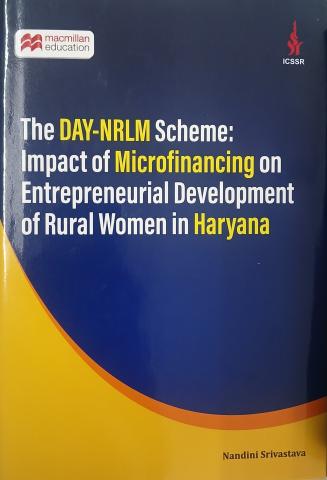
Author : Nandhini Srivastava, Rashmi Singel, Richa Nangia & Vandana Gambhir
Co-publisher: Indian Council of Social Science Research (ICSSR), in association with Macmillan Education India Private Limited.
Publication Year : 2026
Price : 495
About the Book
This study explores how Self-Help Groups (SHGs), supported under DAY-NRLM (Deendayal Antyodaya Yojana-National Rural Livelihoods Mission), are shaping women's economic participation, entrepreneurial journeys, and social confidence across rural Haryana. Drawing from immersive fieldwork, it brings together voices, case studies, and on-ground realities. The book highlights how microfinance is not just about money, but about expanding possibilities-enabling rural women to access markets, enter public life, and challenge gender norms. It examines SHGs as platforms for savings, solidarity, and enterprise, while also capturing variations in their functioning and impact. Through field data and real stories, it reflects on what drives successful outcomes-trust, mentorship, and convergence. It also explores the emotional climate of institutions and identifies key implementation gaps such as limited post-loan support, social exclusion, and capacity constraints. Building on these insights, the study proposes the 6C Model (Clarity, Capacity, Care, Connectivity, Communication, Co-governance) as a replicable framework for strengthening SHGs. At its core, the book emphasizes a shift from compliance to capacity, and from transaction to trust-recognizing that women are already driving their own transformation.
About the Author
Dr. Srivastava currently serves as the Director and Professor at the Council for Doctoral Program, Manav Rachna International Institute of Research and Studies. With over 25 years of professional experience across corporate and academic roles, she brings a rare balance of field insight and academic depth. She has led academic programs, worked with government bodies, guided PhD scholars, and created learning content for the national SWAYAM platform. Her leadership reflects a deep belief in participatory, grounded research that speaks to both policy and people.
An Associate Professor at the School of Leadership and Management, MRIIRS, Dr. Rashmi Singel's work sits at the heart of rural entrepreneurship, women's empowerment, and financial literacy. With nearly two decades of teaching and research, she has contributed to both academic and practical knowledge through published research, patents, conferences, and hands-on training with institutions like IIT Kanpur and the Ministry of MSME. Her work reflects a commitment to ensuring that research lives not just in papers, but in practice.
Currently Associate Professor at Sushant University, Gurugram, Dr. Nangia is an award-winning researcher and mentor. She holds a PhD in Management and has published extensively in reputed journals, led funded research projects, and guided numerous doctoral scholars. Her academic focus lies in organization behaviour, research methodology, and ethics. She believes in inquiry that not only informs but also transforms, and in classrooms that encourage curiosity.
Assistant Professor in Psychology at Lakshmibai College, University of Delhi, Dr. Gambhir's journey began in medicine but found its calling in behavioural science. An internationally awarded trainer and scholar, she works on psychometrics, HR, and communication across cultures. As a certified trainer with the Government of India and the Asia Pacific Career Development Association, her work spans both global and grassroots contexts. Her grounding in Indian philosophy gives her work depth, perspective, and soul.
| Contents | |
|---|---|
| List of Tables | |
| List of Figures | |
| List of Annexures | |
| List of Abbreviations | |
| Acknowledgements | |
| Chapter 1: Introduction | |
| 1.1 Microfinancing Women Self-Help Groups for Business | |
| 1.1.1 Advantages and Limitations of Microfinancing | |
| 1.1.2 Self-Help Groups | |
| 1.2 Need for Organised Microfinancing Schemes in India | |
| 1.2.1 Diverse Microfinancing Innovations | |
| 1.2.2 Success Around the World | |
| 1.3 Deendayal Antyodaya Yojana - National Rural Livelihood Mission (DAY-NRLM) | |
| 1.3.1 Financial Empowerment in DAY-NRLM | |
| 1.3.2 Socially Inclusive Lens of DAY-NRLM: Scheme for the Antyodaya | |
| 1.3.3 Goals and Objectives of DAY-NRLM | |
| 1.4 Haryana State Rural Livelihood Mission (HSRLM) | |
| 1.4.1 Challenges and Interventions in HSRLM | |
| Chapter 2: Methodology | |
| 2.1 Evaluation Framework | |
| 2.2 Research Questions | |
| 2.3 Research Objectives | |
| 2.4 Research Methodology | |
| Chapter 3: Profile of Women Entrepreneurs | |
| Chapter 4: Scheme Details | |
| 4.1 Background and Context | |
| 4.1.1 Understanding the Strategic Gender Interest | |
| 4.1.2 Role of Key Factors: Location, Nature of Business, Accessibility to Market | |
| 4.2 Current Status of Implementation of Scheme | |
| 4.3 Social and Economic Benefits of DAY-NRLM among Self-Help Groups | |
| 4.3.1 Women Empowerment | |
| 4.3.2 Temporal and Spatial Coverage of DAY-NRLM | |
| 4.3.3 Growth Patterns of DAY-NRLM | |
| 4.3.4 Poverty Alleviation | |
| 4.4 Economic and Social Beneficiaries | |
| 4.4.1 Policy Makers | |
| 4.4.2 Society and Entrepreneurs | |
| 4.5 Fund Allocations and Utilization | |
| Chapter 5: Findings and Observations | |
| 5.1 Literature Review | |
| 5.2 Secondary Data | |
| 5.3 Primary Survey Analysis in the Sample Areas | |
| 5.4 Findings and Observations related to Relevance | |
| 5.5 Findings and Observations related to Effectiveness | |
| 5.6 Findings and Observations related to Efficiency | |
| 5.7 Findings and Observations related to Sustainability and Mentoring | |
| 5.8 Findings and Observations related to Outcomes/Impact | |
| 5.8.1 District-wise Analysis | |
| 5.8.2 Category-wise Analysis | |
| 5.9 Gaps in Scheme Design and Challenges in Scheme Implementation | |
| 5.10 Identification of Best Practices: Case Studies | |
| 5.10.1 Thematic Analysis of Case Studies | |
| 5.11 Thematic Analysis of Focus Group Discussion | |
| 5.12 Conclusion | |
| Chapter 6: Recommendations | |
| 6.1 Short-term Recommendations | |
| 6.2 Mid-term Recommendations | |
| 6.3 Long-term Recommendations | |
| 6.4 High Priority Recommendations | |
| 6.5 Thematic Recommendation | |
| References and Bibliography | |
| Detailed Note on Methodology of Study | |
| Annexure | |
| Notes on the Contributors | |