A Journey of Transformation: an Assessment of Sukanya Samriddhi and Beti Bachao Beti Padhao Schemes In Tamil Nadu
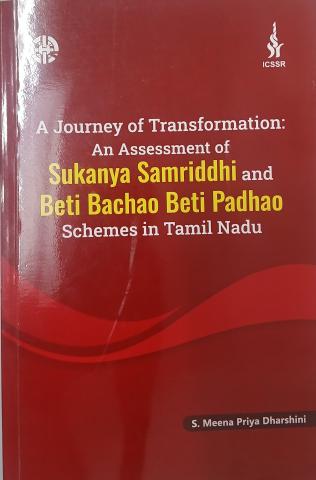
Author : S. Meena Priya Dharshini, K. Kavitha, P. Jeyapriya, A. Rajam, J. Lourdu Vesna, & R. Anusuah
Co-publisher: Indian Council of Social Science Research (ICSSR), in association with HP Hamilton India.
Publication Year : 2026
Price : 495
About the Book
A Journey of Transformation: An Assessment of Sukanya Samriddhi and Beti Bachao Beti Padhao Schemes in Tamil Nadu is a systematic and research-based book. It evaluates two prominent schemes of the Government of India, focused on empowering the girl child in the country. This book has covered five districts of Tamil Nadu state, and examined the 360-degree assessment of the implementation, impact on the life of the girl child socially, economically, educationally and culturally, based on the schemes. It emphasizes the continued disadvantages for girls including gender discrimination, diminishing sex ratio at birth, disparities in education, and healthcare. It discusses how the BBBP scheme contributes to transforming societal attitudes for the well-being of the girl child, and the SSY ensures economic security for girls with long-term savings.
The book is sure to contribute as a policy-oriented document; useful to the policymakers by proposing strategies that need to be implemented to increase the effectiveness of the programmes. It also adds to the overall theme of gender equality by strongly reiterating the need for the overall welfare of girl child through education, inclusion and support for socio-cultural upliftment to achieve sustainable development.
About the Authors
Dr. S. Meena Priya Dharshini has spent almost two decades building a career that's all about teaching, research, and making a real difference. Since 2005, she's been part of the academic world, and now she leads the Department and Centre for Women's Studies at Mother Teresa Women's University. She has published more than 25 research articles in national and international journals and 4 books. She has also completed 20 major and minor research projects, funded by big names like UGC, ICSSR, NABARD, TANCHE, and TNSW. Her projects tackle hard issues: female infanticide, girls' education, and women's empowerment.
Dr. K. Kavitha teaches Computer Science as an Assistant Professor and heads up projects as a Project Director at Mother Teresa Women's University. She specializes in Data Science, AI, Machine Learning, databases, cloud computing, and Software Engineering. She's been part of more than 50 national and international conferences, seminars, and workshops, and her research has made its way into respected journals and conference proceedings. She believes in education, research, and innovation as a path toward sustainable development.
Dr. P. Jeyappriya, Co-Project Director, Registrar i/c (Dean Research), is Professor and Head of the Department of English and Foreign Languages at Mother Teresa Women's University, Kodaikanal. Her areas of specialization are Indian Writing in English, Diasporic Studies, English Language Teaching, and Comparative Literature. Dr. Jeyappriya has received several prestigious awards and has 115 journal publications, 40 conference proceedings, 7 books authored, 5 books edited, and 2 monographs.
Dr. R. Anusuah, Co-Director, is an accomplished academician and researcher serving in the Department of Mass Communication at Mother Teresa Women's University. With a strong commitment to advancing knowledge in media studies, communication, and gender perspectives, she has made significant contributions to teaching, research, and academic development. Her research interests focus on the intersection of media, society, and women's empowerment. She has also published numerous research articles in reputed national and international journals.
Dr Lourdu Vesna J is an eminent academician currently serving in the Department of Mass Communication at Mother Teresa Women's University, Tamil Nadu, India. She has actively engaged in research focusing on the role of media in social transformation, particularly in empowering women and marginalized communities. Her scholarly work reflects an interdisciplinary approach, integrating communication theories with social realities. She has also published research articles in reputed national and international journals.
Dr. (Mrs.) A. Rajam is currently serving as the Director of Physical Education & Sports (i/c) at Mother Teresa Women's University, Kodaikanal. A distinguished academician and sports administrator, Dr. Rajam has published more than 25 research papers and guided 17 M.Phil. and 6 Ph.D. scholars. Her expertise in Yoga and Physical Education has earned her several prestigious recognitions, including the Life Long Achievement Award from Tamil Nadu Physical Education Teachers Association and the Dr. A.P.J. Abdul Kalam International Innovative Faculty Award.
| Contents | |
|---|---|
| Acknowledgements | |
| Acronyms/Abbreviations | |
| List of Figures | |
| List of Tables | |
| 1. INTRODUCTION | |
| 1.1. Need for the Study | |
| 1.2. Significance of the Study | |
| 1.3. Scope of the Study | |
| 1.4. Objectives of the Study | |
| 1.5. Operational Definitions of the Terms | |
| 2. METHODOLOGY | |
| 2.1. Introduction | |
| 2.2. Statement of the Problem | |
| 2.3. Evaluation Framework and Objectives | |
| 2.4. Research Questions | |
| 2.5. Research Design | |
| 2.6. Area of the Study | |
| 2.6.1. Madurai District | |
| 2.6.2. Theni District | |
| 2.6.3. Cuddalore District | |
| 2.6.4. Tiruchirappalli District | |
| 2.6.5. Tiruvallur District | |
| 2.7. Reason for Selecting the Area | |
| 2.8. Sampling Method | |
| 2.8.1. For the Beti Bachao Beti Padhao (BBBP) Initiative | |
| 2.8.2. For the Sukanya Samriddhi Yojana (SSY) | |
| 2.9. Sample Size | |
| 2.10. Data Collection Method | |
| 2.11. Reasons for Choosing Particular Data Sets | |
| 2.12. Tools Used for Data Collection | |
| 2.13. Reliability of the Scale | |
| 2.14. Administration of the Tool | |
| 2.15. Pilot Study | |
| 2.16. Survey of Officials and SSY Beneficiaries | |
| 2.17. Focus Group Discussion (FGD) | |
| 2.18. Case Study | |
| 2.19. Survey Period | |
| 2.20. Data Analysis | |
| 2.21. Limitations of the Study | |
| 3. DISTRICT-WISE, DEMOGRAPHIC, SOCIAL, AND ECONOMIC CHARACTERISTICS | |
| 3.1. Implementation of BBBP-District wise details | |
| 3.2. Sukanya Samriddhi Yojana | |
| 3.3. District wise Demographic, Social and Economic characteristics | |
| 3.3.1. Madurai District BBBP Officials | |
| 3.3.2. Madurai District SSY Beneficiaries3.3.2. Madurai District SSY Beneficiaries | |
| 3.3.3. Theni District BBBP Officials | |
| 3.3.4. Theni District SSY Beneficiaries | |
| 3.3.5. Trichy District BBBP Officials | |
| 3.3.6. Trichy District SSY Beneficiaries | |
| 3.3.7. Madurai District | |
| 3.3.8. Tiruvallur District SSY Beneficiaries | |
| 3.3.9. Cuddalore District | |
| 3.3.10. Cuddalore District SSY Beneficiaries | |
| 3.4. Conclusion | |
| 4. CONCEPTUAL FRAMEWORK AND PROGRAMME DETAILS | |
| 4.1. Introduction | |
| 4.2. Status of Girl Child in India | |
| 4.3. Status Scenario of Girl Children: Navigating Challenges and Aspiring for Change | |
| 4.4. Issues Concerning the Well-being and Development of Girl Children in India: Navigating Challenges toward Empowerment | |
| 4.5. Central Government Schemes and Programmes Initiated for the Empowerment of the Girl Child in India | |
| 4.6. Tamil Nadu Schemes and Programmes for the Empowerment of Girl Child | |
| 4.7. Historical Context and Evolution of Beti Bachao Beti Padhao Initiative | |
| 4.7.1. The Need for Evaluation | |
| 4.7.2. Importance of Beti Bachao Beti Padhao Scheme (BBBP): | |
| 4.7.3. Overall Objectives of the BBBP Scheme | |
| 4.7.4. Historical Context and Objectives | |
| 4.7.5. Objectives of the BBBP Scheme | |
| 4.7.6. Components and Implementation of BBBP Scheme | |
| 4.7.7. Ministry-wise Initiatives of BBBP Scheme | |
| 4.7.8. Individual Contributions | |
| 4.7.9. Eligibility and Tax-Free Scheme | |
| 4.8. Historical Context and Evolution of Sukanya Samriddhi Yojana (SSY) | |
| 4.9. Related Studies on the Beti Bachao Beti Padhao Scheme | |
| 4.10. Review Studies on Sukanya Samriddhi Yojana | |
| 4.11. Research Gap | |
| 4.12. Conclusion | |
| 5. QUANTITATIVE DATA ANALYSIS AND INTERPRETATION | |
| 5.1. Introduction | |
| 5.2. Section 1: Beti Bachao Beti Padhao (BBBP) Scheme Officials Data Analysis | |
| 5.2.1. Personal Profile of the Officials | |
| 5.2.2. Awareness on BBBP Scheme | |
| 5.2.3. Impact of BBBP Scheme | |
| 5.2.4. Association between Impact on BBBP scheme with Collaborative Organisation | |
| 5.2.5. Association between Impacts on BBBP scheme with Designation of the Officials | |
| 5.2.6. Awareness of Sukanya Samriddhi Yojana (SSY) | |
| 5.2.7. Extent of enrolment and retention of girls in local schools | |
| 5.2.8. Key challenges or limitations in the implementation of the BBBP and SSY that may affect its impact on the empowerment of girl children. | |
| 5.2.9. Suggestions for further Development of BBBP and SSY | |
| 5.3. Section II: Sukanya Samriddhi Yojana Beneficiary Data Analysis | |
| 5.3.1. Socio-Economic Status of Respondents | |
| 5.3.2. Awareness on BBBP | |
| 5.3.3. Beneficiaries' Perception of SSY | |
| 5.3.4. Kruskal-Wallis Test103 | |
| 5.3.5. Satisfaction with SSY96 | |
| 6. QUALITATIVE ANALYSIS AND INTERPRETATION | |
| 6.1. Introduction | |
| 6.2 Theme 1: Quality Education | |
| 6.3. Theme 2: Health Care Services | |
| 6.4. Theme 3: Nutrition | |
| 6.5. Theme 4: Child Marriage Prevention | |
| 6.6. Theme 5: Skill Development | |
| 6.7. Theme 6: Cultural Norms. | |
| 6.8. Theme 7: Media Literacy and Parental Involvement | |
| 6.9. Summation | |
| 7. FINDINGS AND OBSERVATIONS | |
| 7.1. Implementation of BBBP-District wise details | |
| 7.2. Sukanya Samriddhi Yojana | |
| 7.3. A Collaborative Triumph of State Initiatives and BBBP | |
| 7.4. Collaboration among Government Departments | |
| 7.5. Collaborative Efforts with Educational Institutions | |
| 7.6. Healthcare Providers' Role in the Initiatives | |
| 7.7. Contributions from Community Organisations | |
| 7.8. Success and Challenges in Collaboration | |
| 7.9. Findings and Observations related to Relevance | |
| 7.10. Findings and Observations related to Effectiveness | |
| 7.11. Findings and Observations related Efficiency | |
| 7.12. Findings and Observations related to Outcome and Impact | |
| 7.13. Findings and Observations related to Sustainability and Monitoring Mechanism | |
| 7.14. Feedback from Focus Group Discussion | |
| 7.15. Findings and Observations related to Issues, Gaps, and Challenges | |
| 7.16. Summation | |
| 8. LIMITATIONS, AND CHALLENGES FOR SCHEME IMPLEMENTATION | |
| 8.1. Optimising BBBP Implementation through SWOC Analysis | |
| 8.2. SWOC Analysis for BBBP Scheme | |
| 8.2.1. Strengths of BBBP Initiatives | |
| 8.2.2. Weaknesses of BBBP Scheme | |
| 8.2.3. Opportunities of BBBP Scheme | |
| 8.2.4. Challenges of BBBP Scheme | |
| 8.3. SWOC Analysis of Sukanya Samriddhi Yojana (SSY) | |
| 8.3.1. Strengths of SSY | |
| 8.3.2. Weaknesses of SSY Scheme | |
| 8.3.3. Opportunities of SSY Scheme | |
| 8.3.4 Challenges of SSY Scheme | |
| 9. CASE STUDY AND BEST PRACTICE | |
| 9.1. Introduction | |
| 9.2. Sukanya Samriddhi Yojana-Case Studies | |
| 9.3. Best Practices of BBBP – Initiative | |
| 9.4. Conclusion | |
| 10. RECOMMENDATIONS | |
| 10.1. Short-Term Recommendations | |
| 10.2. Mid-Term Recommendations | |
| 10.3. Long-Term Recommendations | |
| 10.4. Rationale behind the Recommendations | |
| 10.5. Opinion on the Inclusion of New Stakeholders | |
| 10.6. Suggestions on a New Course of Action | |
| 10.7. Suggestions for Future Research | |
| 10.8. Policy Suggestions to Enhance BBBP and SSY | |
| 10.9. Conclusion of the Study | |
| REFERENCE | |
| ABOUT THE AUTHORS | |