Beyond the Margins: Navigaring the Education, Employment and Psycho-social Realities of the Third Gender in Bihar
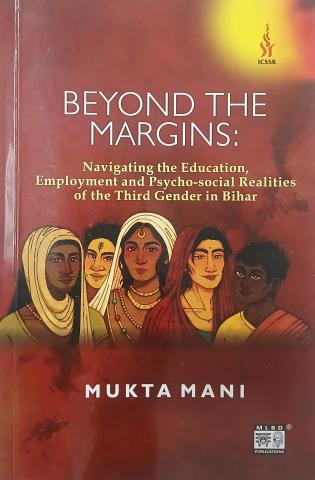
Author : Mukta Mani
Co-publisher: Indian Council of Social Science Research (ICSSR), in association with Motilal Banarsidass Publications.
Publication Year : 2026
Price : 395
About the Book
Indian mythology talks about the Trans presence. There are numerous instances and tales of various characters in our epics who are known for their diverse sexual orientations and gender identities. What could be a better example than the depiction of Lord Shiva as 'Ardhnarishwar"? However, contemporary reality for the third-gender community stands in stark contrast to these ancient traditions. Despite constitutional guarantees of equality, third-gender people, or transgender individuals, face severe social stigma, discrimination, and various forms of gender-based violence, leading to profound socio-economic vulnerability and mental health struggles. To counteract this marginalisation, providing equitable access to education and employment is essential. This book interrogates the current landscape of education and employment for the third-gender community in Bihar from a psycho-social perspective, highlighting the need for systemic change. It not only provides readers with empirical data but also helps 'normalise' transgender experiences in academic and professional discourse, moving beyond stereotypes.
About the Authors
Dr. Mukta Mani is an Assistant Professor in the Department of Education at Patna University, Patna, Bihar. She is an accomplished academic holding a Ph.D. in Education from Patna University, alongside a diverse educational background including an M.Sc. in Zoology, an M.A. in Psychology, and postgraduate diplomas in Higher Education and Educational Management. A recipient of the prestigious ICSSR Postdoctoral Fellowship, she brings nearly 15 years of expertise in teaching and research. A passion for social equity, gender issues, and the integration of technology in modern pedagogy drives her research. An active contributor to the field, she has published several journal papers and authored the book "Inculcating Values through Textbooks.
| Contents | ||
|---|---|---|
| Acknowledgment | ||
| List of Tables | ||
| List of Figures | ||
| Abbreviations Used | ||
| 1. Worldwide Discourse on the Third Gender Community: in Theoretical, Historical and Empirical Perspectives | ||
| 1.1 Background | ||
| 1.2 Transgenders: Historical and Socio-Cultural Discourse | ||
| 1.2.1 Transgenders or the Third Gender in the Recent Era. | ||
| 1.3 Worldwide Discourse on the Status of the Third-Gender Community and International Provisions for their Welfare | ||
| 1.3.1 Global Scenario | ||
| 1.3.2 International Policies and Provisions for the Welfare of the Third-Gender Community | ||
| 1.4 Indian Scenario | ||
| 1.4.1 International Policies and Provisions for the Welfare of the Third-Gender Community | ||
| 1.4.2 International Policies and Provisions for the Welfare of the Third-Gender Community | ||
| 1.4.3 International Policies and Provisions for the Welfare of the Third-Gender Community | ||
| 1.5 Statement of the Problem | ||
| 1.6 Operational Definition of the Terms | ||
| 1.6.1 Third-Gender Community: | ||
| 1.6.2 Psycho-social Realities: | ||
| 1.7 Plan of the Chapters | ||
| 2.Literature Review | ||
| 2.1 Literature Review | ||
| 2.1.1 Studies on the Status and Problems of the Third Gender Community | ||
| 2.1.2 Psycho-social Perspective of Education of the Third Gender Community | ||
| 2.1.3 Psycho-social Perspective of Employment of the Third Gender Community | ||
| 2.2 Research Gap and Rationale of the Study | ||
| 2.3 Research Questions | ||
| 2.4 Aim of the Study | ||
| 2.5 Objectives of the Study | ||
| 2.6 Delimitation of the Study | ||
| 3.Research Methodology | ||
| 3.1 Geographical Area | ||
| 3.1.1 Bihar State Profile | ||
| 3.1.2 Physical Features | ||
| 3.1.3 Bihar Administrative Units | ||
| 3.1.4 Bihar: Key Statistics (As Per Census 2011) | ||
| 3.2 Universe of the Study | ||
| 3.3 Units of the Study | ||
| 3.4 Sample and Sampling Techniques | ||
| 3.4.1 Inclusion and Exclusion Criteria | ||
| 3.5 Sources of Data Collection | ||
| 3.6 Tools for Data Collection | ||
| 3.6.1 Interview Schedule for the Third Gender Community | ||
| 3.7 Procedure of Data Collection | ||
| 3.8 Data Analysis and Interpretation | ||
| 4. Profile of the Study Area and the Third-Gender Respondents | ||
| 4.1 Profile/Demographic Detail of the Areas/ Districts | ||
| 4.1.1 Patna District | ||
| 4.1.2 Muzaffarpur District | ||
| 4.1.3 Bhagalpur District | ||
| 4.1.4 Gaya District | ||
| 4.1.5 Buxar District | ||
| 4.2 Profile of the Third Gender Respondents | ||
| 4.2.1 Age | ||
| 4.2.2 Religion | ||
| 4.2.3 Caste Category | ||
| 4.2.4 Gender Identity | ||
| 4.2.5 Age of Discovering Gender Identity | ||
| 4.2.6 Ownership of House | ||
| 4.2.7 Identity Cards | ||
| 4.2.8 Living in Birth Family or Community Family | ||
| 4.2.9 Age of Leaving Birth Family | ||
| 4.2.10 Reasons for Leaving Birth Family | ||
| 4.2.11 Sexual Partner and Marital Status | ||
| 4.2.12 Choosing a Life Partner | ||
| 4.2.13 Adopting Child | ||
| 4.3 Conclusion | ||
| 5. Social Stigma and Discrimination Faced by the Third-Gender Community | ||
| 5.1 Experiences Throughout Childhood | ||
| 5.2 Problems Facing in Society | ||
| 5.3 Access to Public Services | ||
| 5.4 Reporting Cases to the Police Station and Response of the Police Officer | ||
| 5.5 Existing Social Support | ||
| 5.6 People's Perception Towards the Third-Gender Community | ||
| 5.7 Conclusion | ||
| 6. Psycho-Social Perspective of Education and Employment Among the Third-Gender Community | ||
| 6.1 Existing Status of Education among the Third-Gender Respondents: Issues and Challenges | ||
| 6.1.1 Educational Status | ||
| 6.1.2 Type of Educational Institutions where the Third-Gender Respondents Studied/Study | ||
| 6.1.3 Desire to pursue/continue Education among the Third Gender Respondents | ||
| 6.1.4 Denied Admission Due to Gender Identity | ||
| 6.1.5 Problems in Getting Education | ||
| 6.1.6 Reporting Cases of Abuse and Discrimination and Response of the Principal | ||
| 6.2 Existing Status of Employment among the Third-Gender Respondents: Issues and Challenges | ||
| 6.2.1 Status of Employment/Occupation | ||
| 6.2.2 Monthly Income | ||
| 6.2.3 Problem faced in searching for a Job or Occupation | ||
| 6.2.4 Issues and Challenges at the Workplace or Occupation | ||
| 6.3 Psycho-Social Perspective of Education and Employment of the Third-gender Respondents | ||
| 6.3.1 Impact on the Mental Health of the Third-Gender Respondents | ||
| 6.3.2 Effect of Psycho-social Problems on Various Dimensions of the Personality of the Third-Gender Respondents | ||
| 6.3.3 Effect of the Psycho-social Problems on the Physical Health of the Third- Gender Respondents | ||
| 6.4 Coping Strategies among the Third-Gender Respondents | ||
| 6.5 Conclusion | ||
| 7 Sectoral Initiatives by the Government and NGOs/CBOS Towards the Welfare of the Third-Gender Community: Respondents' Awareness and Expectations | ||
| 7.1 Awareness of the Third-Gender Respondents Towards the Initiatives by the Government | ||
| 7.1.1 Awareness and Knowledge of the Third Gender Status | ||
| 7.1.2 Knowledge about the Bihar State Transgender Welfare Board | ||
| 7.1.3 Awareness of the Government Provisions among the Third Gender Community | ||
| 7.1.4 Status of Getting Benefits from the Provisions/Sectoral Initiatives | ||
| 7.2 Awareness of Third-Gender Respondents Towards the Initiatives by the NGOs/CBOs | ||
| 7.2.1 Knowledge about NGOs/ CBOs and Shelter Home working for the Third-Gender Respondents | ||
| 7.2.2 Role of NGOs/CBOs and Shelter Homes towards the Welfare and Upliftment of the Third-gender Community | ||
| 7.3 Expectations of the Third Gender People from the Government, Society, and NGOs | ||
| 7.3.1 Expectations of the Third-Gender Community Regarding Their Basic Needs and Survival | ||
| 7.3.2 Expectations of the Third-Gender Community Regarding their Education | ||
| 7.3.3 Expectations of the Third-Gender Community Regarding their Employment | ||
| 7.4 Conclusion | ||
| 8 Major Findings, Conclusion, Recommendations, and Limitations of the Study | ||
| 8.1 Major Findings and Discussion | ||
| 8.1.1 Social Stigma and Discrimination Faced by the Third-Gender Community | ||
| 8.1.2 Psycho-Social Perspective of Education and Employment of the Third-Gender Community | ||
| 8.1.3 Sectoral Initiatives (Government and NGOs/CBOs) Towards the Welfare of the Third-Gender Community: Awareness and Expectations of the Respondents | ||
| 8.2 Conclusion | ||
| 8.3 Recommendations | ||
| 8.4 Suggestions for Further Research | ||
| 8.5 Limitations of the Study | ||
| References | ||