Seminar
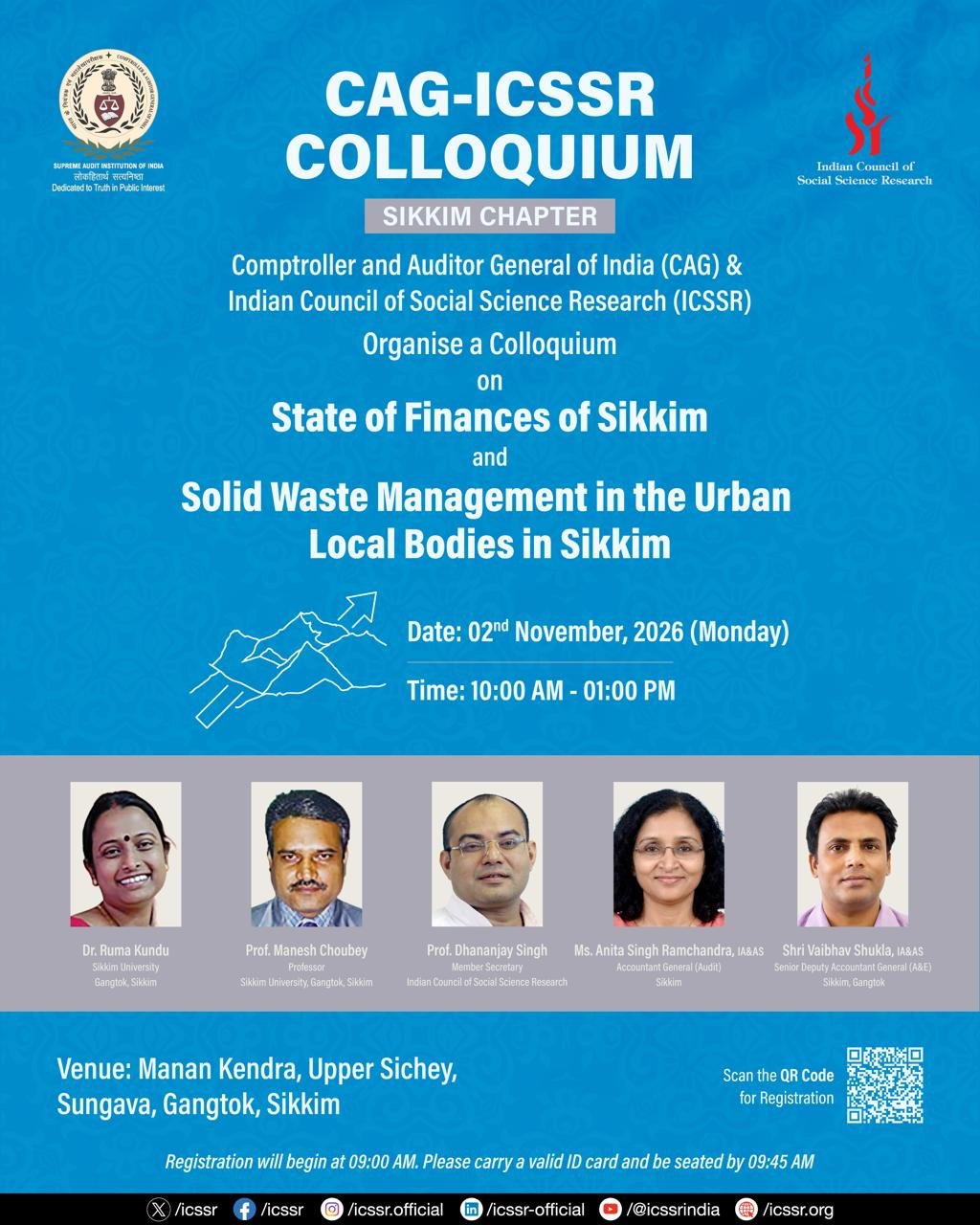
The CAG–ICSSR Colloquium on State Finances of Sikkim and Solid Waste Management in the Urban Local Bodies in Sikkim
Venue: Manan Kendra, Upper Sichey, Sungava, Gangtok, Sikkim
Date: 02 November, 2026
The CAG–ICSSR Colloquium, Sikkim Chapter, was held on 2 November 2026 at Manan Kendra, Gangtok. The colloquium brought together auditors, academics, researchers and students to deliberate on the State of Finances of Sikkim and Solid Waste Management in Urban Local Bodies (ULBs) in Sikkim.
In the Inaugural Session, Prof. Dhananjay Singh, Member Secretary, ICSSR, highlighted the value of CAG audit reports as authentic sources of data for social science research, enabling students to identify gaps in public service delivery, formulate evidence-based research questions and contribute to improved governance. He encouraged young researchers to use audit findings to examine governance challenges and contribute to Viksit Bharat @ 2047.
Ms. Anita Singh Ramchandra, IA&AS, Accountant General (Audit), Sikkim, emphasised the importance of audit insights in strengthening public accountability, understanding fiscal priorities and addressing emerging urban waste-management challenges through informed policymaking. She stressed scientific waste disposal, source segregation, adequate processing infrastructure, legacy waste remediation and stronger municipal accountability.
Shri Vaibhav Shukla, IA&AS, Senior Deputy Accountant General (A&E), Sikkim, presented an overview of the State’s finances (2020–21 to 2024–25), highlighting revenue dependence on central transfers, high committed expenditure and rising outstanding liabilities. He stressed stronger own-source revenue mobilisation, realistic budgeting, improved fund utilisation and prudent debt management.
Prof. Manesh Choubey, Sikkim University, examined Sikkim’s fiscal trends (2010–11 to 2024–25), emphasising revenue diversification, debt sustainability and increased capital expenditure. He advocated growth-oriented policies, tourism and infrastructure development, public-private partnerships and an independent fiscal council.
Dr. Ruma Kundu, Sikkim University, highlighted gaps in source segregation, waste-processing capacity, financial sustainability and implementation of municipal waste-management systems. She advocated decentralised waste management suited to Sikkim’s geographical conditions, phased infrastructure improvements, community participation and stronger monitoring to achieve the State’s Zero Waste target by 2030.
The colloquium reaffirmed the importance of bringing together audit institutions and academia to promote evidence-based research, strengthen public financial management and enhance institutional accountability for sustainable development in Sikkim.
To receive notifications about the latest announcements, follow us on Twitter, Instagram, Facebook, WhatsApp , and LinkedIn.