

FROM POLICY TO PRACTICE: CHALLENGES AND PROSPECTS OF NEP 2020 IN EASTERN AND NORTH-EASTERN INDIA
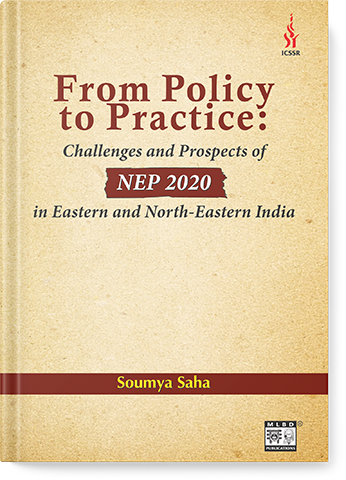
Author : Soumya Saha, Munmun Dey, Somak Biswas, Deepjyoti Choudhury, Sumanta Dutta, & Joy Das
Co-publisher: Indian Council of Social Science Research (ICSSR), Ministry of Education, Government of India, in association with Motilal Banarsidass Publications.
Publication Year : 2026
Price : 195
About the Book
The book, "From Policy to Practice: Challenges and Prospects of NEP 2020 in Eastern and North-Eastern India" offers a timely and insightful exploration of one of India's most ambitious educational reforms the National Education Policy (NEP) 2020. Moving beyond policy rhetoric, this volume explores the realities of implementation across diverse and often underrepresented regions of Eastern and North-Eastern India. The book captures the voices and experiences of key stakeholders in higher education students, faculty members, and institutional administrators grounded in an extensive empirical study supported by the Indian Council of Social Science Research (ICSSR). It critically examines how far the transformative goals of NEP 2020 such as increased access, curriculum flexibility, skill development, and employability are being realized at the grassroots level. The book points out specific challenges in different areas, such as lack of infrastructure, differences in access to technology, how ready institutions are, and economic inequalities, while also showing new chances for innovation, learning across different fields, and growth driven by policy. Through rigorous data analysis, case studies, and stakeholder perspectives, it bridges the gap between policy intent and practical execution. Rich in insights and grounded in real-world evidence, this volume evaluates the effectiveness of NEP 2020 and provides actionable recommendations for policymakers, educators, and academic leaders. It serves as a valuable resource for anyone interested in understanding the evolving landscape of higher education in India and the path toward inclusive and sustainable educational reform.
About the Authors
MUNMUN DEY is an Assistant Professor of Commerce at Vivekananda Mission Mahavidyalaya. She has a thoroughly good academic record and a teaching experience of more than 18 years in Commerce, Management and Finance. Her research interests include financial markets, consumer behaviour, marketing research, social issues, and higher education. She has expertise in dealing with both primary and secondary data and in applying quantitative and qualitative analytics. She has a number of publications in reputed journals.
SOUMYA SAHA is an Assistant Professor in Commerce at Vivekananda Mission Mahavidyalaya, Haldia, Purba Medinipur. He was also associated with the Department of Commerce, University of Calcutta, as a guest faculty. Before that, he was associated with the Post Graduate Department of Commerce, St. Xavier's College, Kolkata, an autonomous institution under the University of Calcutta. He earned his PhD from University of Calcutta. He also completed his Post Graduate Degree in Commerce from the same university. In addition, he earned his Master of Business Administration and M.Phil. (in Management) degrees. He has over 20 years of experience in teaching. He has a large number of research papers to his credit and has presented numerous research papers at various National and International Conferences. He also completed two projects funded by UGC and ICSSR.
SOMAK BISWAS is an assistant professor of economics, specialising in areas such as education and health economics, socio-economic issues, labour issues, and micro-planning for growth. He has been extensively writing on issues in health economics, tourism economics, women's education, women's empowerment, the dynamics of demography, in formalization of labour and women's workforce participation. He has been supervising Ph.D. students in the broad fields of health economics, tourism economics, the dynamics of aging and the healthcare market, education and empowerment of women; the gig economy in Jharkhand; working women in indigenous, non-professional, unorganized industries and trends and potentiality of development of horticulture in Jharkhand. He has completed a research project funded by ICSSR.
DEEPJYOTI CHOUDHURY serves as an Assistant Professor in the Department of Business Administration at Assam University, Silchar, a position he has held since 2010. Specializing in Marketing and Information Systems, his research encompasses areas such as e-banking, consumer behavior, and the integration of ICT in small-scale industries. He has contributed over 20 publications, including journal articles and book chapters, reflecting his active engagement in scholarly communities. Beyond academia, he plays a pivotal role in student placements, having overseen successful recruitment drives with leading companies like ICICI Bank, ITC, and Dalmia Cement. He is also affiliated with various professional bodies, including the FORTUNE Global Advisory Panel and the World Leadership Academy.
SUMANTA DUTTA is presently working as an Assistant Professor of the Postgraduate and Research Department of Commerce (M. Com.), St. Xavier's College (Autonomous), Kolkata. He is the State President (West Bengal) of the Department of Research and Innovation Wing of the Research Foundation of India & National Advisory Board Member of the Research Foundation of India & RFI-CARE. He has over 24 years of experience in teaching and research. He obtained one patent and two copyrights. He has acted as a resource person for more than 110 workshops conducted (both offline and online) by various research bodies in India.
JOY DAS is a Professor in the Department of Commerce at Nagaland University, Kohima, with over 14 years of postgraduate teaching experience and a strong background in finance and banking. He earned his M.Com. (Finance) and Ph.D. in Commerce from Assam University, Silchar, where he was a gold medalist. Before joining Nagaland University in October 2023, he served as an Assistant Professor at Tripura University and Assam University, and also worked in the banking sector as a Customer Relations Associate at the State Bank of India. His research interests include mutual funds, financial inclusion, stock market behaviour, and the impact of macroeconomic variables on financial markets. He has authored over 40 publications and has been cited in various academic studies. He is known for integrating practical financial insights with academic rigor, contributing significantly to commerce education and research in Northeast India.
| Table of Contents | |
|---|---|
| Acknowledgement | |
| Foreword | |
| List of Figure | |
| List of Tables | |
| List of Acronyms/Abbreviations | |
| 1. | ΝΕΡ 2020: An Introduction |
| 1.1. Background, Overview and Context | |
| 1.2. Need for the Study | |
| 1.3. Objectives of the Study | |
| 1.4. Relevance of the Study | |
| 1.5. Data and Sampling | |
| 1.6. Limitation and Mitigation Strategies | |
| 2. | ΝΕΡ 2020: A Students' Perspective |
| 2.1. Exploring the Horizon: Transformative Impact of NEP 2020 on Higher Education | |
| 2.2. Assessing the Provisions of NEP 2020 in Catering to Students' Needs and Aspirations | |
| 2.3. Evaluation Framework of Students | |
| 2.4. Results and Observations | |
| 2.5. Findings | |
| 3. | NEP 2020: A Faculty Members' Perspective |
| 3.1. Prospects and Obstacles of Educational Reform | |
| 3.2. Analysing the Prerequisites of NEP 2020 with regard to Innovation, Multidisciplinary Research and Collaborative Initiatives | |
| 3.3. Evaluation Framework of Faculty Members | |
| 3.4. Findings and Observations | |
| 3.5. Summary of Findings | |
| 4. | NEP 2020: An Administrator's Perspective |
| 4.1. Exploring Opportunities and Challenges in Implementing ΝΕΡ 2020 | |
| 4.2. Evaluation Framework of Administrators | |
| 4.3. Findings and Observations | |
| 4.4. Summary of Findings | |
| 1. | NEP 2020: State-wise Observation and a Case Study |
| 5.1. Key Findings in the State of Assam | |
| 5.2. Key Findings in the State of Tripura | |
| 5.3. Key Findings in the State of Jharkhand | |
| 5.4. Key Findings in the State of West Bengal | |
| 5.5. Relevance of the Scheme | |
| 5.6. Effectiveness of the Scheme | |
| 5.7. Efficiency of the Scheme | |
| 5.8. Outcome/Impact | |
| 5.9. Equity | |
| 5.10. Reach of the Scheme (Based on the Outcome of the Research) | |
| 5.11. Socio-economic Impact of the Scheme (Based on the Outcome of the Research) | |
| 5.12. Geographic Area-wise (Rural/Urban) Observations and Findings | |
| 5.13. A Case Study on Perception, Preparedness and Best Practices Applied regarding Nep-2020 in St. Columba's College, Hazaribagh, Jharkhand | |
| 6. | ΝΕΡ 2020: Overall Recommendations and Policy Suggestions |
| 6.1. Specific Recommendations at the State Level | |
| 6.2. Overall, Policy Recommendations | |
| 6.3. Suggestions to Policy Makers | |
| References and Bibliography | |
| Index | |
| Note About the Authors | |