Massive Open Online Courses (MOOCs): Design And Sustainability In Digital India
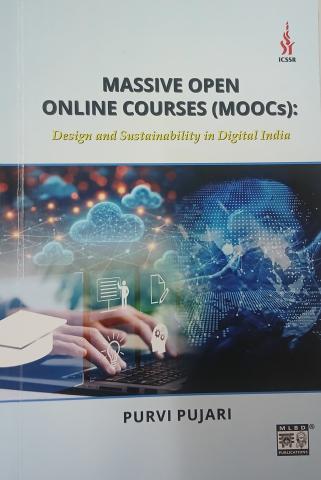
Author : Purvi Pujari
Co-publisher: Indian Council of Social Science Research (ICSSR), in association with Motilal Banarsidass Publications.
Publication Year : 2026
Price : 195
About the Book
This book offers a comprehensive and research-driven exploration of Massive Open Online Courses (MOOCs) within the context of the Indian education system. At a time when higher education is grappling with issues of access, affordability, quality, and employability, the book presents MOOCs as a powerful and scalable solution capable of addressing these systemic challenges. Drawing on extensive empirical research, the author examines the design, sustainability, and effectiveness of MOOCs, with a special focus on learner retention, perceived learning outcomes, and industry relevance. The book goes beyond descriptive discussions by developing a learning analytical model that integrates perspectives from learners, higher education institutions, and industry professionals. It highlights the growing importance of industry-led MOOCs in bridging the skill gap and enhancing employability, especially in a rapidly evolving digital economy. Through detailed data analysis and evidence-based insights, the book identifies key design and implementation factors that influence learner engagement and success.
Structured in a logical progression, the initial chapters introduce the concept and evolution of MOOCs, followed by an in-depth review of literature and research methodology. The later chapters present findings, discussions, and actionable recommendations for policymakers, academic leaders, and corporate stakeholders. Aligned with the vision of the National Education Policy 2020, this book serves as a valuable guide for researchers, educators, and decision-makers seeking to build an inclusive, flexible, and future-ready higher education ecosystem.
About the Author
Dr. Purvi Pujari, the author of this book, is a distinguished academician and researcher with a doctorate in Economics and a gold medal at the postgraduate level. With over twenty-six years of teaching experience across leading universities in the country, Dr. Pujari has made notable contributions to higher education and research. As an institution builder, she has consistently worked to strengthen organizational frameworks, making significant contributions in every role she held. She has successfully led multiple funded research projects in the areas of MOOCs, Learning Analytics, and Indian SMEs, among others, reflecting her strong leadership in scholarly inquiry and project execution. She has served as the editor of multiple books, including Emerging Patterns and Innovations in Massive Open Online Courses (MOOCs) and Empowering a Smart Future through E-Governance and Digitalization. She has authored more than seventy-five research papers, book chapters, and case studies published in SCOPUS, ABDC, and other national and international peer-reviewed journals and conference proceedings, earning several Best Paper Awards. Her scholarly work also includes published copyrights and patents in her name. As an editor and reviewer, she has contributed to leading international academic journals and convene research conferences. She is currently the Dean and Professor at the Vijay Patil School of Management, D.Y. Patil University, Navi Mumbai. Her passion lies in teaching, research, and mentoring future leaders.
| Table of Contents | |
|---|---|
| Acknowledgement | |
| Preface | |
| Foreword | |
| 1. | Massive Open Online Courses (MOOCs) |
| 1.1. | Definition of MOOCs |
| 1.2. | List of a Few Popular MOOCS |
| 1.3. | Origin of the Research Problem |
| 1.4. | Need for the Study |
| 1.5. | Interdisciplinary Relevance of the Study |
| 1.6. | Social Relevance of the Research |
| 1.7. | Definition of Design Factors |
| 1.7.1 Course Design | |
| 1.7.2 Course Structure | |
| 1.8. | Definition of Retention Factors |
| 1.8.1 Instructor Learner Interaction (ILI) | |
| 1.8.2 Instructor Support (IS) | |
| 1.8.3 Instructor Feedback (IF) | |
| 1.8.4 Information Delivery Technology (IDT) | |
| 1.8.5 Perceived Effectiveness (PE) | |
| 1.8.6 Learner Motivation | |
| 1.8.7 Perceived Improvement (PI) | |
| 1.8.8 Perceived Difficulty Level (PD) | |
| 1.9. | Objectives and Research Questions |
| 1.9.1 Industry Study | |
| 1.9.2 Learner Study | |
| 1.10 Research Questions | |
| 1.11 Literature Review | |
| 2. | Research Methodology |
| 2.1. | Data Collection Technique |
| 2.1.1 Industry Questionnaire | |
| 2.1.2 Learners Questionnaire | |
| 3. | Data Analysis and Reporting |
| 3.1. | Industry Study |
| 3.1.1 Hypotheses | |
| 3.1.2 Data Analysis | |
| 3.2. | Learners Study |
| 3.2.1 Background of students/learners | |
| 3.3. | Relationship of designing and implementation factors with Perceived Effectiveness, Perceived Improvement and Retention Nonparametric Correlations |
| 3.4. | Designing Factors and Retention (Chi-square Tables) |
| 3.4.1 Course Design * Retention | |
| 3.4.2 Course Structure * Retention | |
| 3.4.3 Instructor Feedback Retention | |
| 3.4.4 Instructor-Learner Interaction Retention | |
| 3.4.5 Perceived Effectiveness * Retention | |
| 3.4.6 Perceived Improvement Retention | |
| 3.4.7 Perceived Difficulty Level Retention | |
| 3.5. | Logistic Regression |
| 3.5.1 Logistic Regression-Retention | |
| 3.5.2 Logistic Regression - Perceived Effectiveness | |
| 3.6. | The Final Model of Retention |
| 4. | Discussion |
| 4.1 | Industry-led MOOCs |
| 4.1.1 MOOCs as a Recruitment tool | |
| 4.1.2 Industry-led MOOCs Background | |
| 4.2 | Learners (Course Evaluation) |
| 4.2.1 Course Structure (CS) | |
| 4.2.2 Instructor Feedback (IF) | |
| 4.2.3 Instructor Learner Interaction (ILI) | |
| 4.2.4 Course Design (CD) | |
| 4.2.5 Perceived Effectiveness (PE) | |
| 4.2.6 Perceived Improvement (PI) | |
| 4.2.7 Perceived Difficulty Level | |
| 5. | Conclusion and Suggestions |
| 6. | Bibliography |
| 7. | Appendices |
| Appendix-1: The Questionnaire for Learners/Students | |
| Appendix-2: Industry questionnaire | |
| Appendix-3: Course Structure | |